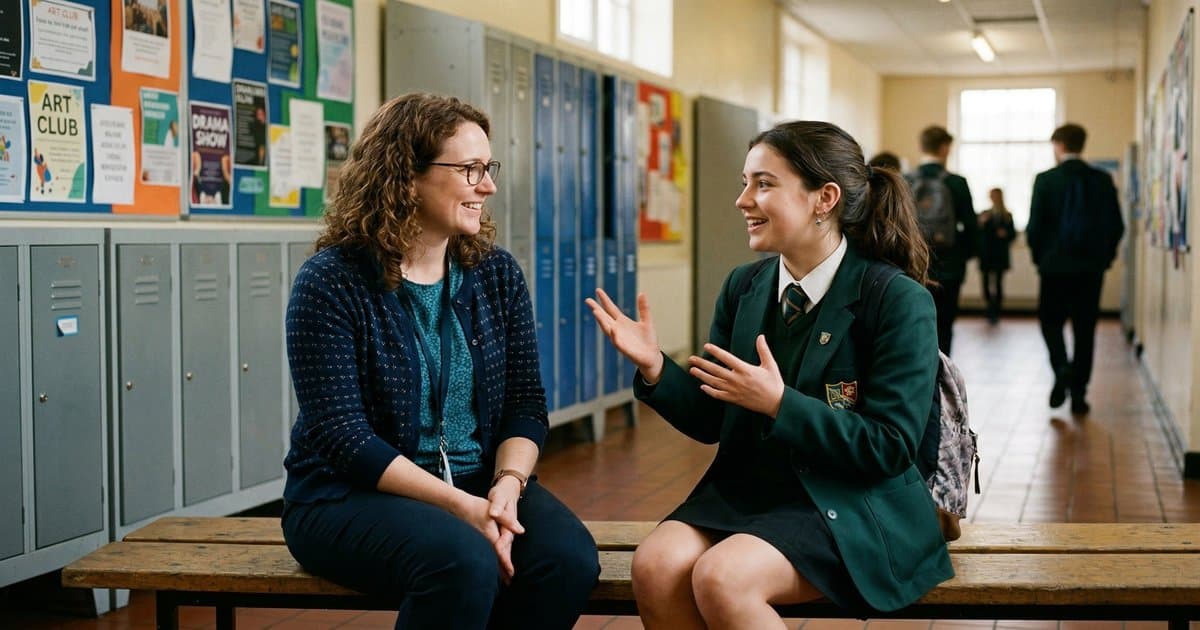
Building trust in trauma-informed teaching means creating the conditions where a student's nervous system feels safe enough to learn. For children affected by trauma, trust is not a soft add-on to good teaching; it is the biological prerequisite. Without it, the brain remains in survival mode and academic engagement becomes physiologically impossible.
Trust is also where #AimingForZero begins, the position ProActive Approaches founder Simon Gower has held since 2016. A reduction target implies there is an acceptable number of restraints, and zero removes that permission. A pupil who trusts the adults around them is far less likely to reach the point of crisis, and for a child affected by trauma, being held can break the very trust a school has worked to build.
- Building trust in trauma-informed teaching starts with predictability: consistent routines signal safety to a dysregulated nervous system.
- Attunement, the practice of noticing and responding to a student's emotional state, is more powerful than any single intervention strategy.
- Repair after rupture matters more than avoiding conflict; how staff respond to relational breaks determines whether trust deepens or erodes.
- Micro-interactions across the school day accumulate into a felt sense of safety that no formal programme can replicate.
- Staff regulatory capacity is foundational: a teacher who cannot self-regulate cannot co-regulate a dysregulated child.
- Trauma-informed trust-building is a whole-school commitment, not an individual teacher's responsibility alone.
Why trust is the prerequisite for learning
The neuroscience is clear. When a child perceives threat, whether real or perceived, the brain prioritises survival over learning. The prefrontal cortex, responsible for reasoning, planning and emotional regulation, becomes functionally inaccessible. No amount of differentiated instruction reaches a brain in fight, flight or freeze.
Trauma disrupts a child's foundational expectation that adults are safe and predictable. Many students arrive in school having learned that adults cause harm, disappear or respond unpredictably. Their nervous systems are calibrated for threat detection. Trust, therefore, is not built through kindness alone; it is built through repeated, reliable experience that contradicts those earlier lessons.
What the research tells us about trauma and school readiness
Adverse childhood experiences (ACEs) are directly linked to difficulties with attention, impulse control and social engagement, all prerequisites for classroom learning. Studies consistently show that children with four or more ACEs are significantly more likely to experience school exclusion, attainment gaps and disengagement. The mechanism is neurological: chronic stress reshapes the developing brain's architecture.
ProActive Approaches draws on the work of Simon Gower, author of The Empathy Gap, to frame trauma-informed practice around the relational, rather than the behavioural. Behaviour is communication; trust is the channel through which that communication becomes possible.
For schools looking to embed this understanding across their workforce, trauma-informed practice training provides a structured foundation for staff at every level.
The biological case for relational safety
Stephen Porges' Polyvagal Theory explains why relational safety is not a pedagogical preference but a neurological necessity. The social engagement system, which governs a child's capacity to connect, learn and co-operate, only activates when the nervous system perceives safety through another person's regulated presence. A calm, attuned adult is not just emotionally helpful; they are neurobiologically necessary.
Predictability as the foundation of trust
For trauma-affected students, unpredictability is threatening. Changes in routine, ambiguous expectations or inconsistent adult responses all register as potential danger signals. Predictability is not rigidity; it is the reliable structure within which a child's nervous system can begin to relax its vigilance.
Schools can build predictability at every level: consistent classroom routines, clear and stable expectations, the same adult greeting the same student each morning. These are not small gestures. For a child whose early experience was chaotic, they are evidence that the world can be trusted.
Classroom structures that signal safety
Visual timetables, consistent seating, predictable lesson openings and closings, and advance warnings before transitions all reduce the cognitive load of uncertainty. When students know what is coming next, they spend less energy scanning for threat and more on learning. The structure itself becomes a trust-building tool.
Practical steps include starting and ending lessons the same way each day, giving verbal and visual five-minute warnings before activity changes, and keeping your physical presence and tone of voice consistent regardless of your own stress levels. The last point is harder than it sounds, and it connects directly to the question of staff regulatory capacity explored below.
Consistency across the whole staff team
Individual teacher consistency matters, but whole-school consistency matters more. A student who experiences warmth in one classroom and unpredictability in the next cannot generalise a sense of safety to the school environment. Trust-building at scale requires shared language, shared expectations and shared practice across every adult in the building.
If your school serves a high proportion of students with complex trauma histories, the schools trauma-informed support pathway from ProActive Approaches offers whole-staff frameworks designed for exactly this context.
Practical consistency includes using the same de-escalation language across departments, briefing supply staff on individual students' needs and triggers, and ensuring that transitions between year groups or key stages are managed relationally, not just administratively.
Attunement and micro-interactions
Attunement is the practice of noticing and accurately reading a child's emotional state, then responding in a way that communicates: I see you, I understand, and you are safe with me. It does not require long conversations or therapeutic skill. It operates in seconds, across hundreds of small moments in every school day.
A brief check-in at the classroom door, noticing that a student seems withdrawn and adjusting your approach, using a child's name with warmth rather than transaction: these micro-interactions are the building blocks of relational trust. Individually they seem trivial. Cumulatively, they are transformative.
The power of being noticed
Many trauma-affected students have internalised the belief that they are invisible, unimportant or fundamentally unlovable. Being genuinely noticed by a trusted adult is a corrective experience. It does not erase trauma, but it begins to revise the neural pathways that encode expectations about relationships.
Simple practices include greeting every student by name at the door, maintaining brief one-to-one contact at least once per lesson for vulnerable students, and noticing positive behaviour before addressing negative. The ratio matters: research in positive psychology suggests a minimum of five positive interactions for every corrective one to maintain a felt sense of relational safety.
Emotional attunement without over-involvement
Attunement does not mean absorbing a student's distress or becoming their therapist. Healthy attunement involves acknowledging the feeling, naming it without drama, and holding steady. "I can see this morning is hard. I'm here and we'll get through the lesson together." This communicates empathy and boundaries simultaneously, which is precisely what many trauma-affected children have never experienced from an adult.
This connects to the approach described in our post on creating trauma-informed safe spaces in the classroom, which explores the physical and relational environment in more depth.
If your team wants to develop these skills in a structured way, our upcoming training events include workshops on relational practice and attunement in school settings.
Repair after rupture
Rupture is inevitable. Teachers have bad days. They raise their voices, make unfair calls, miss a child's distress or respond with frustration. For any student, this is uncomfortable. For a trauma-affected child, a relational rupture can feel catastrophic, confirming every negative expectation they hold about adults.
What matters more than the rupture is the repair. When an adult takes responsibility, apologises genuinely and re-establishes connection, they are doing something profoundly therapeutic: they are demonstrating that relationships can survive difficulty, that adults can be wrong and accountable, and that the connection between them and the child is more durable than a single bad moment.
How to repair effectively
Effective repair is direct, proportionate and timely. It does not require lengthy processing or formal meetings. A brief, private acknowledgement is often enough: "I raised my voice earlier and I shouldn't have. That wasn't fair on you. We're good." The adult models the very relational skills the child needs to develop.
Repair also works the other way. When a student ruptures, the adult's role is to remain regulated, hold the relationship as primary and create an early, low-stakes opportunity for reconnection. This is a skill that requires training and practice, not just goodwill. De-escalation training equips staff with the language and emotional regulation skills to manage these moments without escalating the situation.
Rupture and repair as a trust accelerator
Paradoxically, well-handled rupture and repair can deepen trust more effectively than a relationship that has never been tested. A child who has experienced only relational failures learns, through repeated repair, that this adult is different. The experience is corrective at a neurological level, not just an emotional one.
Our training is certified against the Restraint Reduction Network Training Standards. Manchester Metropolitan University evaluated the RRN Training Standards as a national framework, not our programme directly. The evidence base supports investment in this area as a school-wide priority.Staff regulatory capacity: the missing conversation
Every strategy in this article depends on one thing: the adult's ability to remain regulated under pressure. A dysregulated adult cannot co-regulate a dysregulated child. The window of tolerance for the child is bounded by the window of tolerance of the staff member in front of them.
This is the conversation that trauma-informed practice often avoids, because it places demands on teachers who are already stretched. Yet it is the most important conversation to have. Staff who are chronically stressed, unsupported or emotionally depleted cannot build trust with traumatised children, no matter how good their intentions.
What staff regulation looks like in practice
Regulatory capacity is not about being endlessly calm. It is about having enough internal resource to notice your own state, pause before reacting and choose your response. Schools that take this seriously build staff wellbeing into their trauma-informed frameworks: regular supervision, peer support, explicit permission to seek help and leadership that models the same relational practice it asks of teachers.
ProActive Approaches has over 30 years of experience supporting children and the adults who work with them in schools, and this understanding of staff wellbeing as foundational to student outcomes runs through every aspect of the training we deliver. You cannot pour from an empty cup, and no amount of professional skill compensates for a burnt-out workforce.
Building a school culture that supports staff
Supervision, reflective practice groups and accessible mental health support for staff are not luxuries. They are structural components of a trauma-informed school. Where senior leaders model vulnerability, seek feedback and create psychological safety for staff, those conditions ripple down through every classroom relationship in the building.
To explore how ProActive Approaches can support your school to build this kind of culture, contact our team for a conversation about your specific context and needs.
Frequently asked questions
How long does it take to build trust with a trauma-affected student?
There is no fixed timeline. Some children respond to consistent, warm adult presence within weeks; others with more severe or complex trauma histories may take months or even years. Progress is rarely linear. The key indicator is not time elapsed but whether the student is showing increased willingness to engage, reduced hypervigilance and growing tolerance for relational difficulty.
What should a teacher do when a trauma-affected student pushes them away?
Stay present and do not personalise the rejection. Pushing away is a relational strategy the child learned for self-protection. The therapeutic response is to remain warm, predictable and non-retaliatory, while giving the student enough space to regulate. Saying "I'm here when you're ready" and meaning it is more powerful than any intervention script.
Can building trust conflict with maintaining classroom boundaries?
No, and the framing that it does is a common misconception. Consistent, predictable boundaries are themselves trust-building. What damages trust is unpredictable enforcement, disproportionate consequences or boundaries applied with hostility. Firm, calm and fair boundaries communicate that the adult is in control and the environment is safe, which is exactly what a trauma-affected child needs.
How does staff turnover affect trust-building with traumatised students?
Significantly. For children whose early experience included attachment disruption, losing a trusted adult can feel like abandonment and reinforce negative relational expectations. Schools can mitigate this through warm handovers, overlap periods for key relationships, consistent whole-school culture and ensuring that trust is distributed across a team rather than concentrated in one adult.
What is the role of parents and carers in building school-based trust?
Substantial. A child cannot hold contradictory relational models easily. Where school staff and parents or carers communicate well, use shared language and present a consistent message about the child's value and capability, the effect on trust is compounded. Involving families in trauma-informed approaches, rather than treating the school as an island, significantly strengthens outcomes.
Take the next step for your school
Building trust in trauma-informed teaching is a whole-school endeavour. It requires consistent adult behaviour, relational skills, staff wellbeing infrastructure and shared frameworks that everyone in the building understands and uses.
ProActive Approaches provides trauma-informed practice training that equips whole staff teams with the knowledge, skills and practical strategies to become genuinely trustworthy adults for the students who need them most. Our programmes are grounded in 30 years of practice, independently evaluated, and designed for the real conditions of school life.
Browse our upcoming training events or get in touch to discuss a bespoke programme for your school.