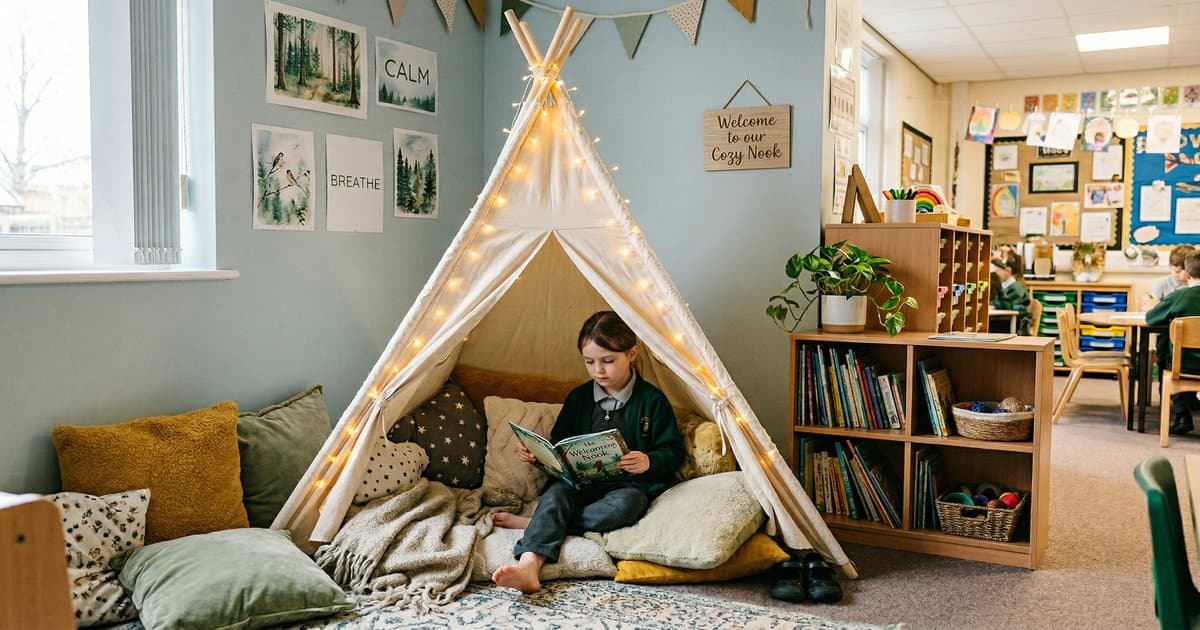
A trauma-informed classroom safe space is a planned part of everyday teaching that helps pupils feel physically and emotionally secure, regulate stress and return to learning with dignity. Using trauma-informed classroom safe spaces strategies means combining predictable routines, warm relationships and practical regulation supports so behaviour is understood as communication rather than defiance.
- Safe spaces work best when they are predictable, taught explicitly and linked to a clear return-to-learning routine.
- Relationships are protective - connection and curiosity reduce escalation more effectively than shame or punishment.
- Behaviour is information, so look for triggers, stress loads and unmet needs before increasing sanctions.
- Regulation supports (breathing, movement, sensory tools) help pupils access expectations, not avoid them.
- Consistency across adults matters, so agree shared language, boundaries and thresholds for support.
- Review impact using pupil voice, staff reflection and simple indicators such as removals, engagement and attendance.
What “safe space” means in a trauma-informed classroom
In trauma-responsive practice, safety is not only the absence of danger. It is the felt sense that an adult will be predictable, respectful and emotionally available, especially when things go wrong. For some pupils, the classroom can feel like a constant threat: noise, proximity, public correction, uncertainty, and rapid transitions can all overload a stressed nervous system.
A safe space is therefore not a reward, a time-out chair, or a place of exile. It is a planned support that reduces threat and increases choice. It gives pupils a way to downshift from survival responses and re-join learning without losing face.
When schools treat safe spaces as part of teaching rather than a behaviour add-on, they become a normal tool for self-management. That is also how you protect learning time: pupils spend less time escalating and more time returning to task with adult support.
Safe space vs removal
Removal is usually adult-led and can feel punitive. A safe space should be predictable, brief, skills-based and followed by a structured reconnection. The goal is not to “send the problem away” but to help the pupil regain enough regulation to participate safely.
Why this matters for outcomes
Trauma-informed approaches emphasise safety, trust, collaboration and empowerment because these conditions reduce the likelihood of re-traumatisation and support recovery. This aligns with widely used trauma-informed frameworks such as SAMHSA’s principles of safety, trustworthiness, peer support, collaboration, empowerment and cultural sensitivity.
Recognising trauma responses without needing the full story
You do not need a pupil’s history to respond skilfully. Trauma-informed practice is about noticing patterns of distress and reducing the conditions that keep the nervous system on high alert. When the brain is scanning for threat, working memory, attention and flexible thinking are harder to access.
In practice, that means the same pupil may cope brilliantly one day and struggle the next. The aim is to reduce shame and increase curiosity: “What happened?” and “What do you need?” rather than “What’s wrong with you?”
Common stress responses you might see
- Fight: arguing, shouting, controlling behaviour, pushing back.
- Flight: leaving the room, refusal, avoidance, running.
- Freeze: going quiet, staring, shutting down, not responding.
- Fawn: people-pleasing, excessive apologising, anxiety about mistakes.
Triggers are often sensory or relational
Triggers are frequently small and cumulative: tone of voice, proximity, crowded corridors, public correction, unpredictable change, loud noise, touch, or perceived unfairness. The key trauma-informed question is not “How do I stop this?” but “What is this behaviour trying to achieve for safety?”
Designing the classroom for predictability, dignity and regulation
Many safe-space wins come from the environment and routines, not from a separate “calm corner”. Predictability reduces anxiety, and clarity reduces the need for pupils to decode adult moods or shifting expectations.
Start with what pupils experience most often: entry, transitions, help-seeking, group work, and endings. If those moments are steady and respectful, you reduce the load on everyone’s nervous system.
Predictable routines and consistent boundaries
Keep routines visible, consistent and taught explicitly. Use a visual timetable, signal transitions, and warn pupils early about changes. Give instructions in small steps and check understanding quietly, not publicly.
Boundaries still matter in trauma-informed practice. The difference is how you hold them: calm, consistent and non-humiliating. Where possible, use private prompts and offer a reset rather than a public power struggle.
Sensory and environmental adjustments
Reduce clutter where you can and make key information easy to find. Consider flexible seating (where appropriate), personal space boundaries, and predictable movement routes. If sound and light contribute to overload, build in quieter options and reduce harsh sensory input.
These changes benefit the whole class. Trauma-responsive practice is often universal design - it helps pupils who are anxious, neurodivergent, tired, or simply having a hard day.
Relational safety: how adults create the conditions for calm
Safe spaces are relational as much as physical. A calm area does not work if pupils expect judgement or rejection when they use it. They also do not work if staff see them as “getting away with it”.
The adult skill is co-regulation: lending your calm, your predictability and your respect until pupils can access their own strategies again. This is one reason ProActive Approaches programmes are built around trauma-responsive behaviour support, with a strong focus on prevention, de-escalation and dignity as a BILD Act (RRN) certified provider.
Connection before correction
Brief moments of connection prevent bigger incidents. A warm greeting at the door, a short check-in, and noticing effort all contribute to felt safety. Use curiosity language such as “I wonder what made that hard today?” rather than blame.
After conflict, prioritise repair. A calm reset conversation when the pupil is regulated strengthens trust and reduces repeat escalation.
Language that lowers threat
In escalation, fewer words usually helps. Keep your voice low, slow your pace, and give physical space. Many pupils escalate when adults move closer or talk faster. Use short supportive phrases such as “You’re safe”, “I’m here”, and “Let’s take a moment”.
Staff consistency and shared scripts
Consistency across adults is a powerful protective factor. Agree shared phrases for entry routines, reminders, choices, and safe-space access. When pupils experience different rules from different adults, it increases uncertainty and threat.
Soft CTA: If your setting is building a shared approach, explore upcoming training dates and short events via our events calendar.
Using safe spaces during incidents: de-escalation, return to learning and repair
A safe space is most effective when it sits inside a simple process that every adult can follow. The process should protect safety, reduce audience effects, and keep the pupil’s dignity intact.
Think of it as a regulation pathway: notice early signs, offer choice, support regulation, then reconnect and return. This is also where de-escalation skills are crucial, especially when distress escalates quickly.
Step 1: notice early cues and reduce demand
Look for early cues: scanning, agitation, muttering, rapid breathing, refusal, shutdown, or leaving seat repeatedly. Reduce the load first - shorten the task, offer a start point, change the format, or offer a short regulated break.
Step 2: offer choice and a dignified exit
Offer two simple choices that protect learning and dignity: “Would you like to sit here or by the window?” and “Do you want a two-minute reset now or after this question?” Choice increases agency and reduces power struggles.
Step 3: regulate, then reflect
Use taught strategies: paced breathing, grounding through the senses, muscle release, or a short movement break. Consider discreet tools such as fidgets, chew items (where safe) or noise-reducing headphones.
Debrief only when calm. Keep it brief and practical: what happened, what helped, what we will try next time. Avoid long lectures that increase shame.
Step 4: restorative repair where harm occurred
If someone has been harmed, restorative practice focuses on accountability and reconnection. The aim is to rebuild relationships and safety, not to “win” the incident. This can include a scripted apology, a repair action, and a plan to reduce repeat triggers.
Mid CTA: To build staff confidence in real-time incident response, many schools combine trauma-informed development with practical de-escalation training and consistent behaviour support approaches such as positive behaviour support.
Whole-school reinforcement: making safe spaces consistent beyond one classroom
Safe spaces fail when they are isolated. Pupils move through corridors, dining halls, playgrounds, transport, and specialist rooms. If the relational approach changes sharply in those spaces, you lose the sense of safety you worked hard to build.
A whole-school approach does not need to be complicated. It needs to be shared, practised and reviewed.
Agree a simple “access and return” protocol
Decide how pupils request the safe space, where it is, how long it lasts, and how return happens. Teach the routine explicitly, practise it when calm, and use the same language across staff.
Clarify how you avoid the safe space becoming avoidance. Track patterns, adjust support, and teach the missing skills. If a pupil uses the space during every literacy task, the issue may be literacy stress, not defiance.
Support plans for pupils with repeated high stress
For pupils who are frequently overwhelmed, create a short support plan focused on triggers, helpful adult responses, early cues, and effective regulation tools. Share it with all relevant staff, including lunchtime and corridor teams.
Staff regulation and reflective practice
Adults need regulation support too. High stress environments increase burnout and reactive responses. Build in short team check-ins, reflective practice, and clear escalation pathways so staff are not left coping alone.
For specialist contexts, explore tailored guidance via our schools hub and, where physical skills are relevant, our approach to physical intervention training that prioritises prevention and dignity.
Practical application: 5 implementable strategies you can start this week
- Teach the safe space routine like any other routine: model how to request it, where to go, what to do there, and how to return to learning, then practise it when everyone is calm.
- Create a two-minute regulation menu: pick 3 to 5 strategies (breathing, grounding, stretch, cold water, movement) and teach them explicitly so pupils can choose quickly when stressed.
- Use a consistent low-arousal script: agree 2 to 3 phrases staff will use in distress, such as “You’re safe”, “I’m here”, “Let’s take a moment”, and remove extra language that increases threat.
- Reduce public correction: switch to private prompts, non-verbal signals, and quiet check-ins to protect dignity and lower the chance of escalation.
- Review weekly with simple indicators: track removals, high-intensity incidents, and pupil feedback on safety and belonging, then make one small adjustment at a time.
FAQ
What is a safe space in a trauma-informed classroom?
A safe space is a predictable, non-stigmatising option pupils can use to regulate stress and return to learning. It is not a punishment or exclusion. In trauma-informed practice, it works best when it is taught explicitly, accessible without shame, and followed by a clear reconnection and return-to-learning routine.
How do we stop a calm area becoming avoidance of work?
Make access structured and time-limited, then teach the return routine. Track patterns rather than assuming manipulation. If the pupil uses the space during the same task type, reduce the demand, adjust scaffolding and teach missing skills. A safe space supports regulation so learning becomes possible, not optional.
What if other pupils say trauma-informed approaches are unfair?
Explain that fairness means everyone gets what they need to succeed. Keep the same safety boundaries for all, but offer different supports so pupils can meet expectations. When calm, use class discussions about regulation and learning needs, and model respectful language that avoids labelling or blame.
What should staff do in the moment when a pupil escalates?
Prioritise safety, reduce audience effects, and lower threat. Use fewer words, a low voice and more space. Offer simple choices and support regulation before problem-solving. Debrief later when calm, focusing on what helped and what to try next time, and include restorative repair if harm occurred.
When should we involve wider support beyond the classroom?
If a pupil is repeatedly overwhelmed, creates safety risks, or cannot return to learning despite consistent support, involve pastoral leads, SENCO and family collaboration. Agree a joined-up plan that includes triggers, early cues and effective responses. The classroom can be supportive, but it should not be the only layer of care.
Closing: build safer classrooms with ProActive Approaches
Trauma-informed classroom safe spaces strategies work when they are consistent, respectful and taught as part of everyday practice. ProActive Approaches supports settings to embed this approach through BILD Act (RRN) certified training that strengthens prevention, de-escalation and trauma-responsive behaviour support.
To develop a shared, practical approach across your team, explore our training pathways including trauma-informed practice training and keep an eye on upcoming events for opportunities to learn and reflect together.