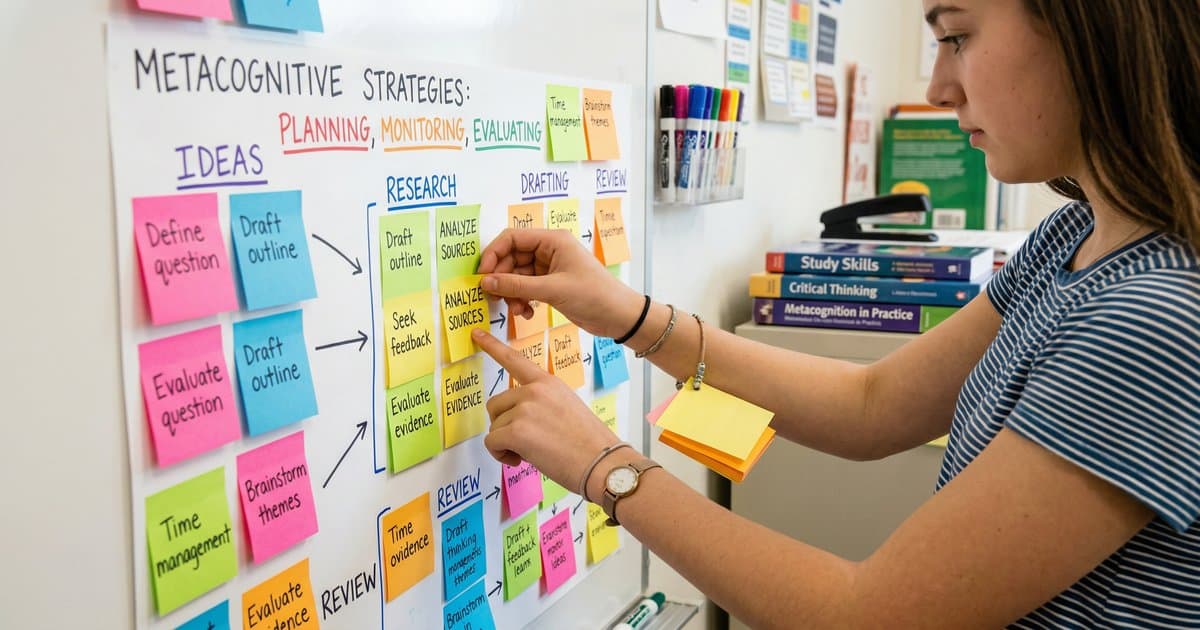
Working memory strategies, tools and activities for students work best when they reduce cognitive load and make key information easy to hold, rehearse and use. Working memory is the mind’s short-term ‘mental workspace’ that temporarily stores and manipulates information during learning, so practical scaffolds such as visuals, checklists, and short retrieval routines help pupils succeed with greater confidence.
- Working memory is a limited-capacity mental workspace that supports following instructions, reading, writing and problem-solving.
- When pupils seem ‘not listening’, the task may be exceeding working memory capacity rather than reflecting low motivation.
- External supports (visual prompts, models, checklists) reduce overload so pupils can focus on understanding and behaviour regulation.
- Short, frequent practice (retrieval, memory games, movement, mindfulness) builds attention and recall over time.
- Consistency across adults, routines and environments creates the biggest gains for pupils who find learning effortful.
Understanding working memory (and why it matters in the classroom)
Working memory is the system that lets a pupil hold information in mind briefly while doing something else with it. It is what helps them remember the start of a sentence while reading the end, hold numbers while completing mental maths, or keep track of instructions while starting a task.
Because working memory has a limited capacity, it is easy for pupils to become overloaded. This can happen quickly when instructions are long, the task involves several steps, the pace is fast, or the environment is distracting.
How working memory difficulties can look like behaviour
When working memory is stretched, pupils may freeze, start but not finish, ask repeated questions, copy inaccurately, or abandon tasks part-way through. Some pupils compensate by masking, joking, refusing, or becoming dysregulated, especially when they feel rushed or shamed.
This is one reason trauma-responsive practice matters. Stress can narrow attention and reduce access to thinking skills, so the same pupil may cope well one day and struggle the next. A calm, predictable environment and clear scaffolds often reduce incidents and increase engagement.
A simple way to explain it to pupils
Many staff find it helpful to describe working memory as a small whiteboard in the mind. You can only fit a few things on it at once, and distractions can ‘rub it out’. This normalises the experience and encourages pupils to use tools without embarrassment.
Early signs a pupil is struggling (and what it usually means)
Noticing patterns helps you match the right support to the right moment. Working memory challenges are often most visible in everyday classroom routines, not in formal assessments.
Common signs across subjects
- Forgetting multi-step instructions or completing only the first step.
- Losing their place when reading, copying, or following a model.
- Difficulty holding ideas while writing, leading to short or disorganised work.
- Needing frequent prompts to start, continue, or check work.
- Appearing distracted when tasks are new, complex, or language-heavy.
Working memory, additional needs and trauma
Pupils with speech and language needs, ADHD, specific learning difficulties, or social communication differences may be more likely to experience working memory overload. Pupils with a history of adversity can also find that stress, uncertainty or perceived threat reduces their ability to hold and process information.
In practice, this means a pupil may need fewer words, clearer structure, and more opportunities to rehearse. Support is not about lowering expectations. It is about removing unnecessary barriers so pupils can show what they know.
Tools that support working memory (and when to use them)
Tools are most effective when they remove the need to ‘hold everything in mind’. Think of them as scaffolds that you can gradually fade as pupils build independence.
Visual organisers and graphic frameworks
Mind maps, concept maps, storyboards, writing frames and KWL grids help pupils organise information externally. This reduces the strain of trying to keep ideas and structure in working memory at the same time.
Start with a partially completed organiser and build towards blank templates. Encourage pupils to keep organisers visible while working rather than treating them as a one-off pre-task.
Step-by-step task cards and checklists
Checklists are one of the simplest ways to reduce overload during independent work. They are particularly helpful for practical tasks, multi-stage writing, problem-solving, and routines such as packing away or transitioning.
Use short, concrete steps. Pair words with icons where appropriate. If you work in a trauma-responsive way, consider offering the checklist as a choice rather than a correction.
Models, worked examples and ‘I do, we do, you do’
When pupils can see an example of what ‘good’ looks like, they do not have to hold an abstract target in mind. Worked examples also reduce the demand of remembering processes while learning them.
Think aloud while modelling so pupils learn the internal language of sequencing, checking and correcting.
Mnemonics and rehearsal routines
Mnemonics, rhymes and simple acronyms help pupils retrieve sequences, lists and procedures with less strain. Ownership matters, so invite pupils to create their own and share them with peers.
Build rehearsal into lessons: short call-and-response, ‘say it back in your own words’, and quick recap questions before moving on.
Timers, time prompts and predictable micro-routines
Time management uses working memory too. Visual timers, time prompts and consistent lesson structures reduce the mental effort of working out ‘how long’ and ‘what next’.
If a pupil is prone to anxiety, use timers gently. Make the purpose supportive (clarity, breaks, pacing) rather than punitive.
Regulation and sensory supports (used intentionally)
Some pupils concentrate better when they can regulate their arousal through movement or sensory input. Tools such as a chair band, wobble cushion, stress ball, or a planned movement break can support focus and memory when agreed and monitored.
Keep expectations clear so the tool supports learning and does not become a distraction. Co-produce a simple plan with the pupil wherever possible.
Activities that build working memory skills (short, enjoyable, repeatable)
Working memory improves through frequent, brief practice that feels safe and achievable. Longer sessions can backfire if they create failure experiences or fatigue.
Retrieval practice as a daily habit
Start lessons with 3 to 5 quick questions that prompt recall of prior learning. Keep it low-stakes and celebrate effort. Retrieval practice helps pupils strengthen recall pathways without requiring them to hold lots of new information at once.
Use a simple structure: ask, wait, prompt, and then model the correct answer. Pupils learn that forgetting is part of learning, not a reason for shame.
Memory games that train sequencing and attention
Classic games like ‘Simon Says’, ‘look, cover, write, check’, matching pairs, and ‘I went to the shop and…’ develop both verbal and visual working memory. Keep sequences short and extend by one item only when pupils are successful.
Pair pupils thoughtfully so they can share strategies. Collaboration reduces pressure and can improve engagement for pupils who feel self-conscious.
Puzzles and brain teasers
Crosswords, logic puzzles, riddles, Sudoku and simple coding challenges encourage pupils to hold multiple pieces of information while testing solutions. They work well as 5-minute starters, calm transitions, or enrichment routines.
Increase challenge gradually. The aim is cognitive stretch without frustration.
Movement-based sequences
Dance routines, clapping patterns, ball games with changing rules, drama warm-ups and musical patterns combine rules, timing and memory. Multi-sensory learning can help pupils encode information more strongly, especially when they struggle with language-heavy tasks.
Give one instruction at a time and model it physically. Then build the sequence, naming each step consistently.
Mindfulness and grounding for attention control
Short breathing or grounding routines can help pupils settle into learning and reduce distraction. Two minutes of a consistent routine can make a noticeable difference, particularly after transitions or break times.
Try box breathing (inhale 4, hold 4, exhale 4, hold 4) with finger counting. Keep language simple, predictable and non-judgemental.
Embedding working memory support into everyday teaching (whole-staff consistency)
Working memory support is most effective when it is built into routines, not bolted on as an intervention. Pupils benefit most when every adult uses similar language, structures and expectations.
Reduce overload before it happens
- Break tasks into short steps and display them visually.
- Use one instruction, then check, then the next instruction.
- Repeat key points and ask pupils to rephrase them.
- Pre-teach essential vocabulary to reduce language load.
- Use worked examples and success criteria that stay visible.
Make support feel normal, not remedial
Use memory routines as whole-class starters or transitions so pupils are not singled out. When supports are part of the culture, pupils are more likely to use them independently.
A soft next step is to invite staff to share what works. If you want ideas and live modelling, browse upcoming training events and webinars where practitioners swap practical strategies and resources.
Link working memory to regulation and relationships
In trauma-responsive settings, working memory support sits alongside safety, predictability, and relational connection. A calm tone, clear routines, and repair after moments of dysregulation help pupils return to thinking.
As a BILD Act (RRN) certified provider, ProActive Approaches emphasises skills that reduce distress and improve outcomes. Many organisations report up to an 80% reduction in incidents when they embed consistent approaches to support, de-escalation and safer responses.
Practical application: 5 strategies you can implement this week
- Instruction routine: Give one step at a time, display it visually, then ask pupils to say it back in their own words before starting.
- Externalise the process: Create a simple checklist or task card for recurring tasks (for example, ‘how to start independent writing’) and keep it on desks.
- Daily retrieval: Use a 5-minute low-stakes recall starter at the beginning of lessons, then revisit the same questions later in the week.
- Teach a strategy explicitly: Pick one method (chunking, rehearsal, visualisation) and practise it as a class so pupils can name it and choose it.
- Build predictability: Standardise transitions with a consistent visual cue, a timer, and a short grounding routine to protect attention and reduce stress.
FAQ
What are early signs a pupil is struggling with working memory?
Common signs include forgetting multi-step instructions, losing their place, copying inaccurately, or appearing ‘distracted’ when tasks become complex. You may also see task avoidance, repeated questions, or emotional escalation when the pupil feels overloaded. These patterns often indicate that the demand has exceeded working memory capacity rather than a lack of effort.
How quickly can working memory improve?
Some pupils improve quickly when you reduce overload with practical supports such as visuals, checklists and shorter instructions. Building skills usually takes longer and benefits from short, frequent practice across weeks and terms. The key measure is everyday impact - fewer repeated prompts, better task completion, and calmer responses to challenge.
Are apps and training programmes a good idea?
Apps and programmes can be helpful when they are targeted, enjoyable, and monitored by staff. The most important question is whether gains transfer into real classroom tasks, not just improved scores in an app. If you try a programme, track outcomes weekly and gather feedback from the pupil about what feels easier.
How do I support working memory without lowering expectations?
Keep learning goals high, but make the route achievable. Reduce unnecessary load by breaking tasks into steps, keeping success criteria visible, modelling examples, and offering scaffolded tools pupils can use independently. As confidence grows, fade prompts gradually so pupils build self-management rather than dependency.
What helps most for pupils affected by stress or trauma?
Predictability, clear routines and emotionally safe relationships protect attention and thinking. Use calm, concise language and avoid giving long verbal instructions when a pupil is dysregulated. Offer visual supports, short options, and time to process. Trauma-informed practice helps pupils feel safer, which increases access to working memory for learning.
Next steps with ProActive Approaches
If you want a whole-staff approach that links working memory support with regulation, relationships and safer responses, ProActive Approaches can help. Explore our support for schools, our trauma-informed practice training, and our positive behaviour support programmes to build consistent strategies across adults and settings.
ProActive Approaches brings 30+ years experience to training and implementation support, helping organisations strengthen practice and reduce restrictive responses. For practical next steps, view upcoming events or contact the team to discuss what would make the biggest difference for your learners.