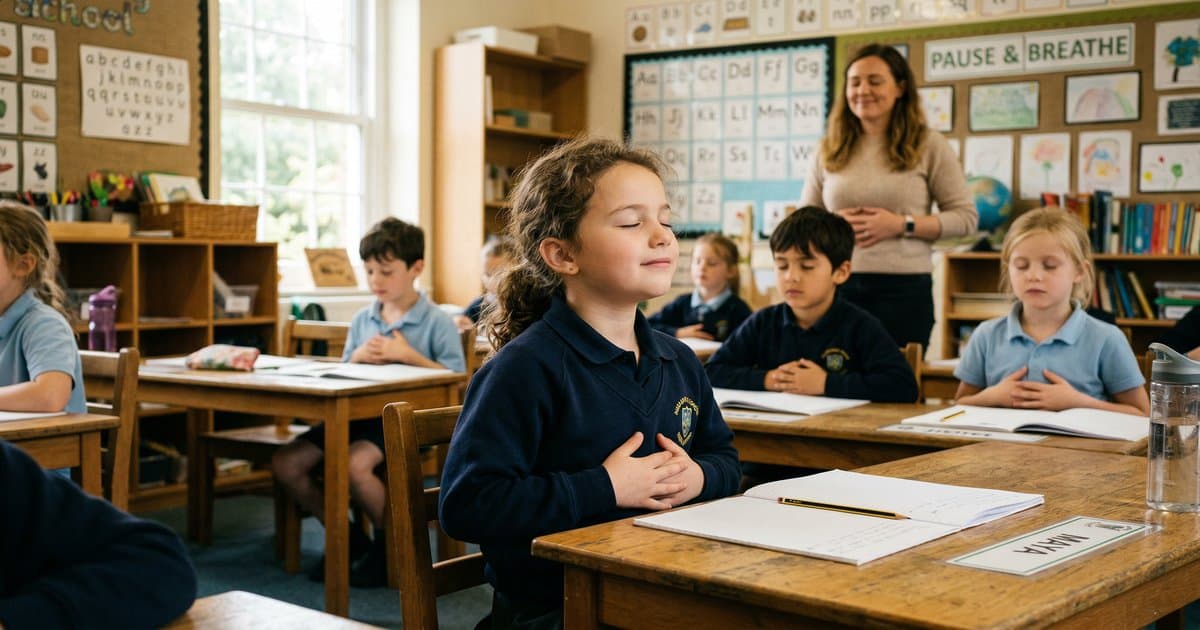
Self-regulation in the classroom is the teachable ability for pupils to notice what they feel, manage impulses, and return to a ready-to-learn state using supportive routines and strategies. It develops through co-regulation, modelling, and practice - not through willpower alone. When schools teach it explicitly, pupils cope better with challenge, transitions, and repair after conflict.
- Self-regulation is a skillset that grows through consistent co-regulation, modelling, and rehearsal during calm moments.
- Predictable routines and clear expectations reduce stress, increase safety, and prevent escalation before it starts.
- Emotional literacy and body awareness help pupils spot early signs of dysregulation and ask for support sooner.
- A small everyday toolkit (breathing, grounding, movement, sensory supports) works best when practised little and often.
- Targeted plans and dignified reset routines support pupils who struggle most, without lowering expectations.
What self-regulation means in a school setting
Self-regulation is often described as a pupil "calming down" or "controlling themselves". In reality, it is a wider set of skills that includes noticing emotions, understanding body signals, managing stress responses, and choosing actions that support learning and relationships. In classrooms, it shows up in everyday moments: starting tasks, coping with frustration, waiting for a turn, transitioning between activities, and repairing after conflict.
It also helps to separate self-regulation from compliance. A pupil may look "fine" because they are quiet, but they might be shut down, fearful, or dissociated. Another pupil may look "challenging" because they are loud or restless, but they may simply need support to downshift their nervous system before they can access thinking and language. A trauma-responsive approach keeps curiosity at the centre: what is this behaviour communicating, and what skill or support is missing?
Core components you can observe and teach
You can teach self-regulation the same way you teach reading or writing - by breaking it into small, observable parts and practising them regularly.
- Emotional awareness - noticing feelings and the body cues that come with them.
- Emotional regulation - using strategies to return to calm or steady alertness.
- Impulse control - pausing before acting when stressed.
- Goal-directed persistence - staying with a task when it is difficult.
- Cognitive flexibility - shifting perspective, trying another way, or accepting a change of plan.
When staff share language and practice, pupils get a consistent message: feelings are normal, and skills can be learned. That consistency is one of the strongest protective factors a school can offer.
Why self-regulation matters for learning, resilience and relationships
Learning requires access to thinking, working memory, and language. When a pupil feels safe and regulated, the brain can focus on learning, problem-solving, and social connection. When a pupil feels unsafe or overwhelmed, the brain prioritises survival. In school, this can look like fight, flight, freeze, fawn, or switching off.
Understanding this shifts practice from "Why are they doing this?" to "What is happening for them, and what do they need next?" It also supports staff to hold firm boundaries without escalating the situation. Regulation is not about removing expectations. It is about helping pupils access the skills they need to meet expectations successfully.
Learning and attainment
Pupils who can regulate are better able to focus, organise themselves, and persist with challenge. This is particularly important during transitions, complex tasks, and times of uncertainty. Small self-regulation habits - like a predictable start-of-lesson routine or a short grounding cue - can protect learning time for everyone in the room.
Resilience and wellbeing
Resilience grows through manageable stress with effective support. Each time a pupil is helped to recover from dysregulation, they learn that difficult feelings are tolerable and temporary. Over time, pupils internalise the strategies and need less adult input. This is why co-regulation is not "rescuing". It is skill-building.
Peer and adult relationships
Self-regulation supports turn-taking, conflict repair, empathy, and social problem-solving. When classrooms normalise feelings and teach repair, pupils experience less shame and more belonging. That sense of belonging is strongly linked to behaviour, attendance, and engagement.
Soft CTA: If you want practical ideas you can implement quickly, explore upcoming workshops and online sessions on events and training dates.
Trauma-responsive strategies that build self-regulation
Trauma-responsive practice starts with the assumption that behaviour is communication. Many pupils have learned to stay safe through hypervigilance, control, avoidance, or aggression. In those moments, they are not choosing poorly - they are surviving. The goal is to create conditions where thinking skills can return, and then teach the missing regulation skills in small, achievable steps.
For schools, this means combining relational safety with predictable structure. You are building an environment where pupils can borrow your calm, practise skills, and recover with dignity when things go wrong.
Teach emotional literacy weekly, not only after incidents
Emotional literacy gives pupils the language and insight they need to regulate. Build it into tutor time, circle time, PSHE, and everyday teaching.
- Use a simple feelings chart and revisit it daily.
- Teach body cues like tight chest, clenched fists, hot face, fast breathing, or "buzzy" legs.
- Practise short noticing statements: "I can feel worry in my stomach" or "My hands are tight".
- Model validating phrases: "That makes sense" and "You are safe with me".
When pupils can name what is happening inside, they can ask for help sooner. That is a prevention strategy, not an add-on.
Model regulation and repair when you get it wrong
Pupils learn as much from staff nervous systems as they do from lesson content. Modelling regulation means narrating small, authentic steps in the moment.
- Use a calm script: "I am feeling rushed. I am going to slow my breathing."
- Pause before feedback, consequences, or corrections.
- If you snap, repair briefly: apologise, restate the boundary, reconnect.
Repair teaches a powerful message: relationships can recover. It also supports pupils who carry shame from past experiences of conflict.
Build predictable routines and supportive structure
Consistency reduces uncertainty and helps pupils conserve regulation resources. Predictability is not about rigid control - it is about safety.
- Post a simple visual schedule and preview changes early.
- Use 3 to 5 positively worded expectations that staff can teach and refer to consistently.
- Support transitions with countdowns, roles, and "first-then" language.
Where incidents are frequent, it can also help to strengthen adult consistency through shared behaviour support approaches such as positive behaviour support training.
Everyday regulation tools pupils can practise in class
In high-stress moments, pupils struggle to access complex instructions. This is why a small toolkit works better than a long list. Pick a few strategies, teach them explicitly, practise them daily when calm, and agree how pupils can use them without feeling singled out.
Think of these strategies like spelling rules or times tables: the power comes from repetition. The aim is to make regulation supports normal classroom practice, not a special intervention only used after conflict.
Breathing that is age-appropriate and practical
Breathing can work well, but only when it is simple and taught as a skill rather than a demand. For younger pupils, concrete images are often better than counting.
- Box breathing - breathe in 4, hold 4, out 4, hold 4.
- Hot chocolate breathing - smell the drink, then cool it slowly.
- One breath reset - a single slow breath paired with a cue word like "steady".
Grounding and orientation back to the room
Grounding supports pupils who feel overwhelmed, panicky, or disconnected. It helps the brain re-orient to the present moment.
- 5-4-3-2-1 senses - name things you can see, feel, hear, smell, taste.
- Feet and seat - notice feet on the floor and body on the chair.
- Spot five objects - look for five items of the same colour.
Movement and pressure for safe release
Some pupils regulate through movement or proprioceptive input. Planned movement prevents conflict later.
- Wall press or chair push-ups for 20 seconds.
- Short walk with an adult and a clear return point.
- Stretch break linked to a lesson transition.
Sensory supports and environmental adjustments
Sensory needs can be a major driver of dysregulation. Small adjustments reduce load without disrupting learning.
- Noise reduction options where appropriate.
- Fiddle tools used with clear guidance.
- Water breaks and calm spaces agreed in advance.
Co-regulation first: supporting pupils through escalation
Many pupils, especially those with trauma histories or additional needs, need an adult to lend calm before they can self-regulate. This is co-regulation. It is not lowering standards. It is providing the bridge back to thinking, language, and problem-solving.
When a pupil is escalated, reduce demands, reduce language, and prioritise safety. If staff try to teach, reason, or correct too early, pupils often escalate further. A regulated adult nervous system is one of the most effective de-escalation tools available.
What co-regulation looks like in practice
- Keep your voice steady and your language short.
- Offer simple choices: "Sit here or by the door?"
- Lower the audience: reduce peer attention where possible.
- Hold boundaries with warmth: "I cannot let you hurt anyone. I will help you get safe."
When risk rises: clarity and consistency
In higher-risk moments, teams need shared scripts and consistent thresholds. Training can support this consistency and reduce restrictive practices by improving early intervention and de-escalation. ProActive Approaches is BILD Act (RRN) certified and supports organisations to build safer, more consistent responses.
Where physical risk is a realistic possibility, staff should be confident in prevention and response, including de-escalation training and, where relevant, physical intervention programmes.
Mid CTA: If you want to align staff responses and reduce escalation across the day, explore our trauma-informed practice training and practical guides for schools and services.
Supporting pupils who struggle most: targeted, dignified plans
Whole-class strategies matter, but some pupils need targeted support. Frequent shutdown, avoidance, or explosive reactions often indicate skill gaps, unmet needs, or stress responses that require a more individualised approach. The aim is not to create special rules - it is to create a fair plan that helps the pupil access learning and relationships safely.
Targeted support works best when it is co-produced with the pupil during calm moments, shared consistently with key staff, and reviewed regularly. It should describe the pupil's early warning signs, what helps, what makes things worse, and how adults will respond.
Signs a pupil may need targeted regulation support
- Repeated dysregulation at predictable times, such as transitions or unstructured periods.
- High sensitivity to correction, noise, touch, or perceived unfairness.
- Difficulty repairing after conflict, with lingering shame or anger.
Targeted supports that work in real classrooms
- Create an individual regulation plan with triggers, early signs, and helpful adult responses.
- Agree a short, supervised "reset" routine that is time-limited and skills-based.
- Use visual prompts and check-ins such as colour zones or number scales.
- Coordinate with SENCO, pastoral teams, and families for consistency.
If you support pupils across different settings, you may find resources in our schools hub helpful for aligning language and practice.
Practical application: five strategies you can implement this week
- Start every lesson with a 60-second regulation routine - one breath cue, a brief body check, and a simple "ready to learn" prompt.
- Introduce a class toolkit of three strategies - for example, one breathing option, one grounding option, and one movement option, then practise them daily for two weeks.
- Create a predictable transition script - countdown, clear "first-then" instruction, and a consistent role or responsibility for pupils who struggle with change.
- Plan a dignified reset route - agree where a pupil can go, who supports them, what they do for 3 to 5 minutes, and how they return to learning.
- Use repair after conflict - short, structured repair conversations that focus on safety, impact, and next steps, not blame.
FAQ
What is the difference between self-regulation and self-control?
Self-control is mainly about inhibiting impulses in the moment. Self-regulation is broader and includes recognising emotions, managing stress responses, and using strategies to return to a ready-to-learn state. In school, this means teaching skills like noticing body signals, using coping tools, and repairing relationships after conflict.
Do mindfulness activities work for all pupils?
Mindfulness can help many pupils, but it is not one-size-fits-all. Some pupils find it uncomfortable or exposing, particularly if they have experienced trauma. Offer choice, keep practice short, and include other options such as movement, grounding, and sensory supports. The best approach is the one pupils will actually use.
How can we teach self-regulation without lowering expectations?
Keep expectations clear and consistent, and pair them with support. Regulate first, teach and reflect second. Use routines, co-regulation, and repair so pupils can meet expectations more successfully over time. This approach protects learning, strengthens relationships, and reduces repeated cycles of conflict and consequence.
What should we do when pupils refuse regulation activities?
Resistance is information, not disrespect. Explain the purpose in a way pupils care about, offer two or three choices, and start very small - even 30 seconds can be enough. Keep practice normal by integrating it into routines rather than positioning it as a special intervention only used after incidents.
How do we know if our approach is working?
Track patterns rather than perfection. Monitor frequency and intensity of dysregulation, recovery time, and pupil self-report about what helps. Also check staff confidence and consistency. Improvement often shows up first as quicker recovery and fewer high-intensity incidents, before you see sustained changes in behaviour data.
Next steps
Self-regulation improves most when adults share language, practise consistently, and respond predictably under pressure. ProActive Approaches brings 30+ years experience and BILD Act (RRN) certified training to help schools build calm, consistent, trauma-responsive practice that reduces escalation and supports learning. Explore our events or get in touch to find the right programme for your setting.